
Direct Answer
What information is needed to configure a custom motor test bench?
To configure a custom motor test bench, define the engineering decision, motor type, rated and peak torque, rated and maximum speed, power and voltage context, load profile, duration, mechanical drawing, controller and cooling interfaces, measurement channels, software and report needs, safety and site conditions, and acceptance method. Missing values can begin as documented assumptions, but operating limits, interfaces, safety, and verification criteria must be resolved before design release.
Configuration Logic
Six decisions that shape the system.
Motor and operating envelope
Motor type, rated and peak torque, rated power, maximum speed, voltage platform, current, duty cycle, and expected overload define the working range.
Loading method
The loading unit is selected around torque, speed, power, transient response, cooling, test duration, and the real application load profile.
Mechanical interface
Shaft drawing, flange, mounting direction, coupling, guard, alignment, fixture changeover, and service access determine the bench structure.
Measurement and synchronization
Torque, speed, voltage, current, power, temperature, and optional channels should be synchronized with the test sequence and report requirements.
Control, safety, and software
Control mode, automated sequences, pass/fail logic, emergency stop, protection, English interface, data storage, curves, and report workflow should be agreed early.
Project environment
R&D, quality control, end-of-line, laboratory, or production use affects station count, automation level, operator workflow, site layout, and documentation.
Engineering Principle
Specify the test workflow, not only the equipment name.
A request for a “motor dynamometer” or “motor test bench” becomes actionable when it explains what the team needs to prove: a torque-speed curve, efficiency map, temperature rise, endurance result, dynamic response, production pass/fail judgment, or a traceable report. That workflow determines how loading, measurement, software, and fixtures work together.
For an overview of the complete system, see the custom motor test bench product page. For a selection-first view, read how to choose a motor test bench.
Input-to-Decision Matrix
How each buyer input changes the test-bench configuration.
A useful RFQ does more than list motor values. Each input should connect to a design decision and a verification record.
| Input group | What to provide | Configuration consequence |
|---|---|---|
| Test objective and decision | R&D characterization, validation, endurance, QC, EOL, comparison, or troubleshooting; required test items and acceptance method | Defines whether the system needs flexible engineering control, repeated validation, production judgment, or a combination |
| Motor identity and operating envelope | Motor type, rated and peak torque, rated and maximum speed, rated power, voltage/current platform, direction and operating quadrants | Sizes loading, driveline, power, measurement ranges, protection and cooling without treating one headline value as the complete requirement |
| Load profile and duration | Steady points, ramps, steps, reversals, maps, cycles, dwell, overload, continuous duration and repetition | Separates peak capability from continuous thermal duty and defines the control sequence |
| Mechanical interface | Dimensioned shaft/flange drawing, mounting direction, coupling space, runout/alignment needs, fixture variants, guarding and service access | Determines base, coupling, fixture, alignment method, changeover and safe physical layout |
| Motor control, power and cooling | Controller/inverter, command and feedback interfaces, supply or battery simulator, braking/regeneration path, cooling circuits and utilities | Defines electrical integration, control ownership, energy flow, thermal boundaries and site preparation |
| Measurement and evidence | Required channels, ranges, units, accuracy expression, calibration/traceability needs, synchronization, sampling definition and environmental conditions | Defines the measurement chain and the records needed to interpret accuracy, repeatability and acceptance |
| Software and data workflow | Sequence editing, permissions, alarms, calculations, raw data, curves, report fields, language, barcode, PLC/MES and retention | Defines how a test becomes a repeatable and auditable engineering or production record |
| Safety, site and acceptance | Target country, applicable procedure, risk inputs, floor space, power/utilities, operator workflow, FAT/SAT, training, documentation and support boundaries | Defines project compliance review, installation conditions, verification scope and handover responsibilities |
Requirement Maturity
Different project stages need different levels of detail.
| Stage | Minimum useful input | Expected output |
|---|---|---|
| Initial configuration review | Test objective, motor type, rated/peak torque, rated/maximum speed, power/voltage context, priority tests, application, target country and available drawing | A bounded concept with explicit assumptions and open questions |
| Technical proposal | Operating envelope, load profile, duration, mechanical interface, controller/power/cooling, channels, software, site and acceptance expectations | A system architecture, scope, options, exclusions and preliminary verification plan |
| Design freeze | Approved drawings, interfaces, utilities, safety inputs, test procedures, measurement definitions, report fields, versions and change process | Released design baseline and controlled changes |
| FAT/SAT preparation | Identified test article, agreed sequence, conditions, calibration status, tolerance, raw-data/report method, responsibilities and sign-off rules | Executable acceptance record rather than a marketing specification |
Use the Motor Test Bench RFQ Checklist to collect the initial information, then confirm project-specific design and acceptance records during engineering review.
Quotation Preparation
Information that helps a manufacturer make the right proposal.
- Motor specification sheet with rated and peak values
- Mechanical drawing for shaft, flange, mounting, and coupling discussion
- Required test list, internal procedure, or applicable standard
- Load profile and test duration, especially for endurance or transient work
- Controller, drive, voltage platform, cooling, and communication information when relevant
- Required report fields, language, traceability, and pass/fail workflow
Limits and Evidence Boundaries
What this configuration guide does not assume.
- Rated power alone cannot define a test bench. Torque-speed combinations, peak and continuous duty, direction, duration, cooling and the required test sequence can lead to different system choices.
- A component specification does not automatically prove complete-system measurement performance. Sensors, instruments, installation, signal processing, synchronization, environment and calculation methods must be considered together.
- A preliminary proposal may contain documented assumptions when some inputs are unavailable. Safety, operating limits, interfaces and acceptance criteria still need agreement before design release.
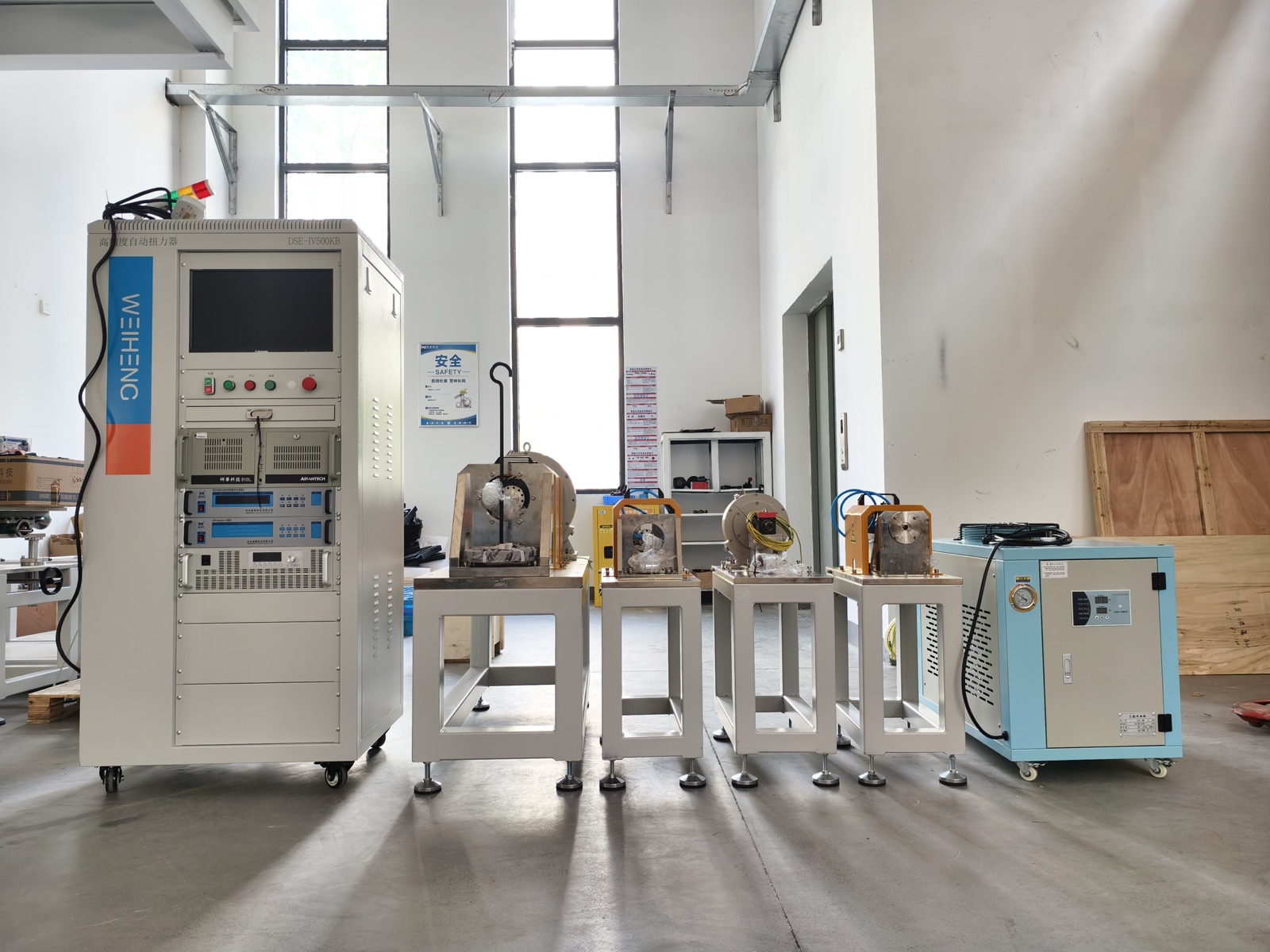
- The real equipment photograph verifies that Weiheng has integrated a physical control cabinet, loading units, fixtures and cooling equipment. It does not prove a specific range, accuracy, response, project result or acceptance status.
FAQ
Custom Motor Test Bench Questions
What does a custom motor test bench manufacturer need for quotation?
The most useful inputs are motor type, rated and peak power, torque, maximum speed, voltage or current information, required tests, drawings, application, and whether the project is for R&D, QC, EOL, or laboratory work.
Can one test bench support more than one motor model?
It can be discussed when the torque, speed, power, mechanical interface, fixtures, and test workflow are compatible. The practical solution may use adjustable fixtures, a modular layout, or defined changeover procedures.
Why are fixtures important in a motor test bench?
Fixtures affect alignment, repeatability, safety, changeover time, and the realism of the test setup. A motor test bench is not complete until the mechanical interface is considered with loading and measurement.
Should a buyer specify only rated power?
No. Rated power alone is not enough to select a system. Peak torque, maximum speed, duty cycle, loading profile, test duration, and required transient behavior can materially change the configuration.
Can a proposal start if some motor data are missing?
A preliminary configuration can start from the available motor, application, test objective, operating range, drawing, and site information, but assumptions and open items should be listed. Safety, interfaces, limits, and acceptance criteria must be resolved before design release.