
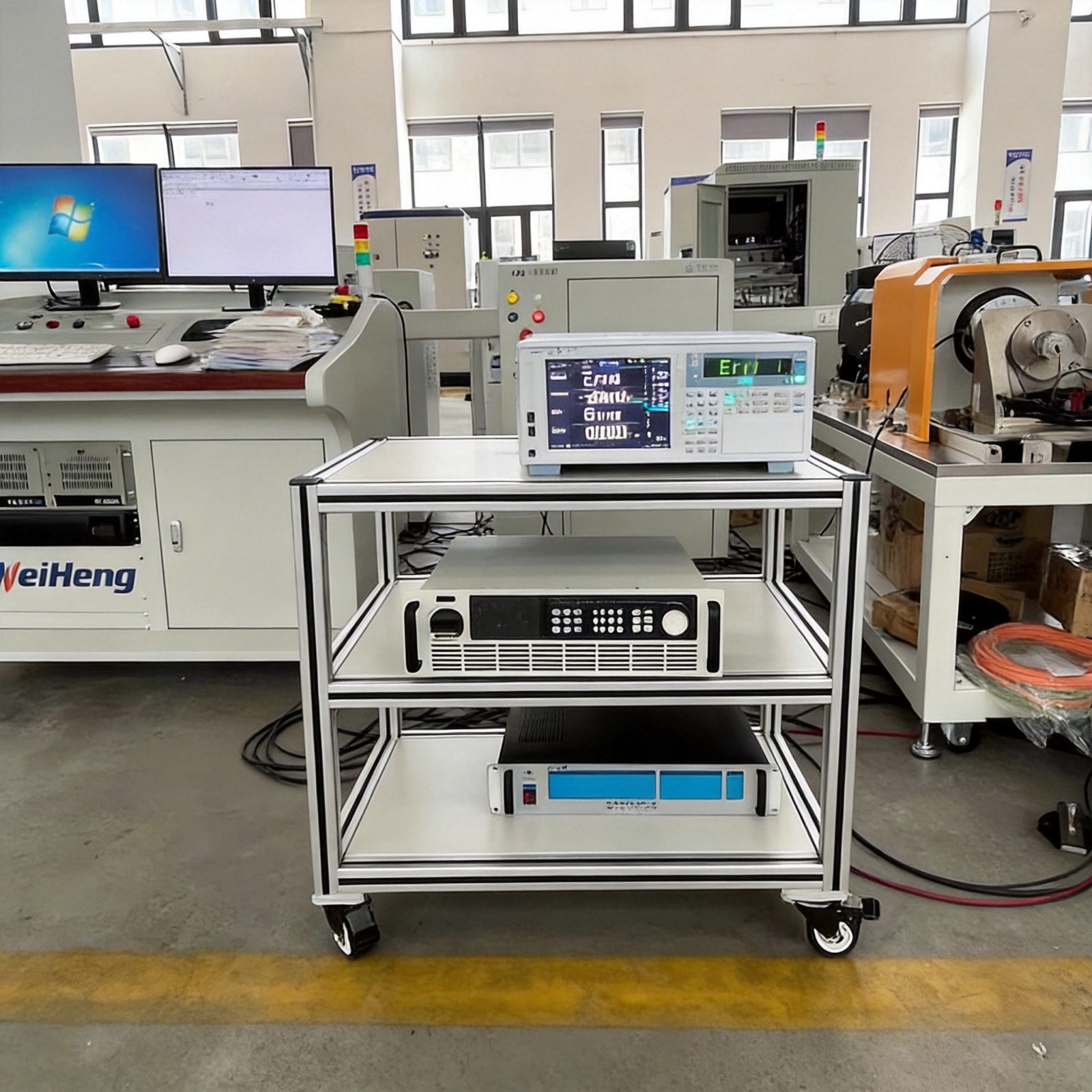
Direct Answer
How should a motor EOL test system be specified?
A motor EOL test system should make a repeatable release decision for each identified unit within the approved production workflow. Define detectable defects, test sequence, fixture and contacting, measurement and limit rules, cycle-time budget, safety, recipe and version control, retest and quarantine routes, and MES/report fields before selecting hardware. Acceptance should challenge known conditions, interface failures, traceability completeness, limit permissions, recovery behavior, and the sustained target production scenario.
Release Workflow
Seven linked steps from unit identity to confirmed handoff.
| Step | Required definition and evidence |
|---|---|
| 1. Identify and authorize | Read the unit, product, variant, order, batch, or lot identity; verify that the correct approved recipe, limits, fixture, permissions, and station state are active. |
| 2. Load and make safe | Confirm positioning, contacting, coupling or loading, guarding, utilities, interlocks, operator clearance, and a declared safe response to faults or interruption. |
| 3. Run the approved sequence | Execute only the required checks with defined conditions, stabilization, timing, channels, units, calculations, and stop rules. |
| 4. Validate the run | Separate a valid pass or fail from an invalid, aborted, communication-lost, fixture-fault, or instrument-fault run before applying release logic. |
| 5. Judge and route | Apply the approved limit revision and decision rule; assign result and defect codes; then release, hold, quarantine, rework, scrap, or route to controlled retest. |
| 6. Write the record | Link measured values and status to unit identity, recipe and limit revision, station/software state, timestamps, operator or automation identity, exceptions, and retest lineage. |
| 7. Confirm handoff | Verify database, MES, PLC, label, marker, conveyor, or downstream acknowledgement so a result is not treated as released when the production handoff failed. |
Test Coverage
Choose checks from the release decision—not from a universal EOL list.
- No-load current, speed, direction, start-stop, and application-specific functional checks
- Torque, speed, voltage, current, power, or controlled-load points where the release decision requires them
- Resistance, insulation, withstand, sensor, communication, temperature, noise, vibration, or custom signals where required
- Fixture, connector, interlock, guard, recipe, and product-identity checks
- Version-controlled limits, automatic judgment, defect codes, and invalid-run handling
- Unit-, batch-, or lot-linked records, retest history, disposition, reports, and factory-system acknowledgement
Final scope depends on the motor or assembly, known manufacturing risks, application, quality plan, production workflow, target country, and agreed acceptance method.
Cycle-Time Budget
Specify the complete station cycle, not only active measurement time.
| Budget element | What the timing definition should include |
|---|---|
| Identification and recipe | Scan/read, lookup, validation, recipe and limit loading |
| Handling and contacting | Load, orient, clamp, connect, couple, guard, interlock, and settle |
| Test execution | Stimulus, ramp, stabilization, measurement windows, repetitions, and controlled stop |
| Calculation and decision | Signal validation, calculations, limits, combined logic, defect code, and status |
| Data and interface | Record write, report/label/marking, MES or database acknowledgement, and retry rules |
| Unload and transfer | Disconnect, unclamp, unload, sort, conveyor transfer, or operator confirmation |
| Abnormal and changeover cases | Invalid run, retest, reject routing, recovery, variant change, maintenance, and warm-up |
Record the start event, end event, included and excluded time, product mix, staffing, warm-up, target and allowed variation, reporting statistic, data source, observation period, and sustained acceptance scenario. A best single cycle does not prove production capacity.
Decision Governance
Every pass or fail needs a versioned, auditable rule.
| Decision field | Minimum useful definition |
|---|---|
| Characteristic | Stable requirement or test ID, measured quantity, unit, calculation, and DUT boundary |
| Condition | Product/variant, recipe, operating point, direction, timing window, fixture, temperature, and required station state |
| Limit | Lower/upper or other rule, inclusive/exclusive boundary, source, revision, effective date, and approval owner |
| Validity | Sensor/communication/interlock state, stabilization, missing-data, saturation, interruption, and invalid-run rules |
| Outcome | Pass, fail, invalid, aborted, hold, warning, or another approved state; silence and communication loss are not pass |
| Exception flow | Defect code, retest eligibility and count, rework/quarantine route, override permission, reason, audit record, and final disposition |
Traceability Record
Store enough context to reconstruct what happened to one unit.
| Record group | Minimum useful fields |
|---|---|
| Identity | Unit serial or approved batch/lot identity, product and variant, work order, fixture/pallet where relevant |
| Test definition | Sequence, recipe, software, limit-set and calculation revision; configuration or checksum where required |
| Execution context | Station, line/location, date/time/time zone, operator or automation identity, shift, fixture and relevant instrument identifiers |
| Results | Step status, raw-data reference, measured/calculated values with units, limits applied, alarms and overall outcome |
| Exceptions | Invalid/aborted reason, defect code, override, rework, quarantine, maintenance or communication event |
| Lineage | Original run, retest links, previous outcome, changed condition or repair, final disposition and approval |
| Handoff | MES/database/PLC acknowledgement, report/label/marking state, downstream routing and any failed-write recovery |
GS1's traceability framework separates object identity and event data into “what, where, when and why,” while ISA-95 addresses information exchange between manufacturing control and enterprise functions. The exact identifiers and interface design remain project-specific.
Acceptance Matrix
Eight checks before the station becomes a production release gate.
| Acceptance area | Evidence to define and retain |
|---|---|
| Requirement coverage | Each approved requirement ID maps to a sequence step, condition, result field, decision rule, evidence and sign-off owner. |
| Known-condition challenge | Approved representative units or simulated conditions challenge pass, fail, boundary, missing-signal, wrong-variant and invalid-run behavior without claiming universal defect coverage. |
| Measurement suitability | Required channels have documented range, installation, verification/calibration status, synchronization and decision suitability for the selected checks. |
| Cycle and capacity | The complete load-to-handoff workflow is demonstrated under the agreed product mix, staffing, interfaces and sustained scenario; test-only time is not substituted for total station cycle. |
| Traceability | Records are queried forward and backward from unit identity, and recipe/limit revisions, retests, disposition and interface acknowledgements remain linked. |
| Permissions and changes | Recipe, limits, overrides, software, users, backup/restore and change approval are challenged with attributable audit records. |
| Fault and recovery | Power, network, instrument, fixture, safety, database and downstream-interface faults reach the agreed safe/hold state and recover without false release. |
| FAT, SAT and production handover | Factory scope, site interfaces, open items, retest, training, maintenance, spare/backup deliverables and final acceptance remain separately recorded and signed. |
Reference Boundaries
Standards organize the data and interfaces; they do not define Weiheng project performance.
The ISA-95 series describes enterprise-control integration and manufacturing-operations information. The OPC Foundation ISA-95 test-result model includes result identity, description, date, result and unit fields. The GS1 Global Traceability Standard explains object identification, event data, locations, time, process context, and different traceability precision levels.
These sources support record and interface structure only. They do not prove Weiheng cycle time, defect coverage, accuracy, software compatibility, compliance, or completed project acceptance.
Limits and Evidence Boundaries
What this page and photograph do not prove.
- EOL is a production release workflow, not proof of complete design validation, lifetime reliability, regulatory compliance, or every possible defect. The quality plan must define the defects and decisions the station is intended to address.
- A target cycle is incomplete without its start/end events, product mix, operator/automation assumptions, included handling and data time, statistical reporting rule, abnormal cases, and sustained-production acceptance scenario.
- A pass/fail label without unit identity, step results, limit and recipe revisions, validity checks, retest lineage, disposition, and write acknowledgement is not a complete traceability record.
- The page uses an AI-edited marketing image based on an equipment scene to illustrate a possible station layout. It does not verify a specific project, physical integration, instrument reading, cycle time, detection coverage, measurement performance, traceability, false-accept/false-reject rate, MES integration, or acceptance.
Before Quotation
Inputs that make an EOL proposal comparable and acceptance-ready.
- Motor or assembly drawing, variants, connectors, product identification, fixture and handling requirements
- Defects and release decisions to address, source requirements, test IDs, test items, conditions, limits and invalid/retest rules
- Target production workflow, product mix, load-to-handoff cycle definition, volume, shifts, changeovers and availability assumptions
- Required measurements, instruments, units, calculations, calibration/verification, raw data, reports and retention
- Barcode/DMC/RFID, recipe, permissions, PLC/MES/database interfaces, acknowledgement, offline behavior and cybersecurity boundary
- Safety, utilities, installation space, operator roles, maintenance, backup/restore, FAT/SAT, training, target country and contract responsibilities
If the station is for EPS, pump, fan, seat, door, wiper, compressor, or another vehicle subsystem, first define the operating and acceptance boundary in the automotive component motor testing route. If the project may require R&D mapping or endurance validation rather than production pass/fail testing, compare the routes in the electric motor test bench selection matrix and review the wider motor testing equipment system boundary. Use the Motor Test Bench RFQ Checklist for requirement IDs and supplier responses, compare workflow boundaries in the R&D Test Bench vs EOL Test System guide, define records and sign-off evidence in the Motor Test Data and Acceptance Planning Guide, and review broader inputs in the Custom Motor Test Bench Configuration Guide.
Copy and Complete
Prepare an EOL project brief without guessing missing values.
Copy this brief into the RFQ notes, an email, or a technical-meeting request. Mark unknown values TBD. The completed brief helps Weiheng separate confirmed requirements, assumptions, options, exclusions, and the proposed verification stage; it does not guarantee technical feasibility or a quotation.
EOL MOTOR TEST SYSTEM PROJECT BRIEF

1. Company and country/region:
2. Contact name and business email:
3. Motor or assembly type:
4. Product variants and identification method (barcode/DMC/RFID/other):
5. Rated or operating values (power, voltage, current, torque, speed; mark TBD where unknown):
6. Production decision required (release/grade/rework/quarantine/other):
7. Defects or test items to address:
8. Cycle definition (start event, end event, target, product mix and included handling/data time):
9. Fixture, loading, contacting and operator/automation requirements:
10. Result rules (pass/fail/invalid/retest) and traceability/report fields:
11. PLC/MES/database/label/line interfaces and acknowledgement needs:
12. FAT, SAT, training and handover expectations:
13. Installation country, utilities, space and target project timing:
14. Available drawings, specifications, sample parts or existing reports:
15. Requested next step (configuration review / proposal / technical meeting / project evaluation):
16. How did you find Weiheng? (ChatGPT / Gemini or Google AI / Copilot / Perplexity / Search / Social / Referral / Other):
FAQ
Motor End-of-Line Test System Questions
What is a motor end-of-line test system?
A motor end-of-line test system is a production-oriented station that identifies a motor or assembly, runs an approved sequence, validates the run, applies version-controlled decision rules, routes the unit, and stores a traceable result before shipment or the next manufacturing step.
How should EOL cycle time be specified?
Define the load-to-handoff start and end events, product mix, staffing and automation assumptions, handling, contacting, stabilization, measurement, calculation, data write, acknowledgement, unload, abnormal recovery, changeover, and the sustained-production scenario used for acceptance.
What should an EOL traceability record contain?
Link unit, product and order identity to station, operator or automation identity, timestamp, recipe/software/limit revisions, step results, values and units, overall status, defects, invalid runs, retests, disposition, and MES or database acknowledgement.
Can a failed motor be tested again?
Only under an approved rule. Define which failure or invalid conditions allow retest, permitted count, repair or setup change, authorization, linkage to the original run, result precedence, quarantine route, and final disposition. Repeating until pass is not a valid rule.
Does every motor EOL station need a dynamometer?
No. Loading depends on the defects and release criteria the station must address. Some sequences use no-load, electrical, safety, sensor, communication, noise or vibration checks; others require controlled load. The proposed method must fit the production decision and cycle.
How should an EOL station be accepted?
Challenge requirement coverage, representative pass/fail/boundary/invalid conditions, measurement suitability, full station cycle, traceability queries, permissions and version changes, interface failures, safe recovery, FAT/SAT scope, open items, training and signed handover.