
Direct Answer
What should a motor test bench RFQ include?
A motor test bench RFQ should define the decision, complete DUT, torque-speed-power-time envelope, duty cycle, quadrants, interfaces, measurement channels and evidence, fixtures, control, safety, software, site, delivery and acceptance stages. Mark every field as known, target, TBD, supplier-proposed or excluded. Require the proposal to state assumptions, calculations, scope, options, exclusions, FAT/SAT method, deliverables, responsibilities and contract boundaries so different suppliers can be compared on the same basis.
RFQ Checklist
Ten requirement groups from test decision to acceptance.
| Requirement group | What the RFQ should state | Why it matters |
|---|---|---|
| 1. Decision and project context | R&D, validation, comparison, endurance, QC, EOL, audit or laboratory service; decision, users, stakeholders, program timing and future variants | Defines flexibility, automation, capacity, evidence and sign-off needs |
| 2. DUT identity and boundary | Motor/module type, included inverter/controller/feedback/cooling, model list, drawing/revision, serial or sample status and buyer/supplier items | Prevents testing or quoting different system boundaries |
| 3. Operating envelope and sequence | Rated/peak torque and speed, required torque-speed points, power/voltage/current context, direction/quadrants, duty, ramps/steps/maps/cycles, dwell, overload, repeats and thermal state | Sizes loading, driveline, power, cooling, measurement and protection |
| 4. Loading, power and utilities | Absorb/motoring/regenerative states, control modes, command/feedback interface, supply or battery simulator, braking/energy path, cooling and site utilities | Defines loading technology, energy flow and site preparation |
| 5. Mechanical interface | Dimensioned shaft/flange, orientation, coupling, alignment/runout, bearing-load limits, mass, fixtures, guarding, critical-speed input, service and changeover | Defines physical layout, repeatability, safety and maintainability |
| 6. Measurement and calculations | Channels and planes, range, units, smallest points, accuracy expression, calibration/traceability, uncertainty, synchronization, timing, filters, formulas, invalid data and retest | Defines what a reported value means and how it will be verified |
| 7. Control and safety | Control ownership, modes, limits, alarms, interlocks, emergency stop, safe state, risk inputs, operator roles, applicable procedure and target country | Defines integration and risk-reduction review without assuming one universal compliance route |
| 8. Software, data and reports | Sequence editing, permissions, versions, raw export, calculations, curves, report fields, language, barcode/PLC/MES, retention, backups, cybersecurity and change control | Defines the auditable workflow and handover deliverables |
| 9. Site, delivery and support | Layout, environment, utilities, Incoterms, packing, documentation, installation, remote access, training, spares, warranty, service window and exclusions | Defines buyer/supplier responsibilities and overseas contract boundaries |
| 10. Acceptance and commercial response | Design review, FAT, shipment release, SAT, commissioning and final acceptance; method, DUT, condition, tolerance, record, witness, invalid/retest, punch list and sign-off | Makes technical promises comparable and contract-ready |
Open-Item Discipline
Every field needs a status, not a guessed value or silent blank.
| Status | How to use it |
|---|---|
| Known | A value or requirement is confirmed and a source/revision can be supplied. |
| Target | The buyer has a desired outcome, but the final method or tolerance still needs engineering agreement. |
| TBD | The item is open; record an owner, dependency and resolution date instead of leaving a blank. |
| Supplier-proposed | The supplier must state its assumption, basis, consequence, alternative and verification method. |
| Excluded | The item is intentionally outside scope; state who supplies it and any interface or acceptance dependency. |
Supplier Response Matrix
Require a traceable response instead of an unstructured quotation.
| Response field | Minimum useful content |
|---|---|
| Requirement status | Repeat each item as compliant, deviation, option, excluded or clarification required; never rely on silence. |
| Technical basis | Provide calculation, selected component, drawing, architecture, method or project assumption supporting the response. |
| Scope and interfaces | Identify supplier/buyer items, quantities, connections, utilities, software ownership, documents and site responsibilities. |
| Evidence and deliverables | List raw data, curves, reports, certificates, calibration records, manuals, source/configuration files and training records included. |
| Verification stage | Assign design review, FAT, shipment, SAT, commissioning or final acceptance, with method, condition, tolerance, witness and sign-off. |
| Exceptions and changes | State exclusions, deviations, optional costs, dependencies, change-control route and commercial/schedule consequence. |
| Traceability | Use requirement IDs and revision control so the RFQ, proposal, design baseline, test record, punch list and final acceptance stay linked. |
Before Quotation
Why the test objective changes the configuration.
For example, an R&D system may prioritize flexible test sequences, transient data, curve analysis, and iterative fixtures. A production or end-of-line system may prioritize repeatable loading, operator workflow, pass/fail logic, automatic reports, and traceability. The same motor can therefore need different test bench configurations in different contexts.
Review the motor test bench system overview or use the selection guide before sending the RFQ.
Reference Boundaries
Selection, safety and acceptance need separate records.
Magtrol's custom-system selection guidance asks for motor type, maximum torque/speed/power, measured parameters and available utilities, and shows that a complete system can include loading, control, power measurement, supply, fixtures, software and commissioning. Its products and capabilities do not prove a Weiheng proposal.
ISO 12100 provides machinery risk-assessment and risk-reduction principles across lifecycle phases. ISA-105/IEC 62381 guidance supports pre-test planning, readiness, documentation, hardware/software/interface checks, punch lists, completion criteria and clear roles for FAT/SAT/SIT; its process-industry scope must not be presented as automatic Weiheng compliance.
Limits and Evidence Boundaries
What an RFQ, supplier response and photograph do not prove.
- An RFQ is not a frozen design. Documented assumptions can support an initial proposal, but operating limits, safety, interfaces, measurement definitions and acceptance criteria must be resolved before design release.
- A supplier's claim of compliance is not evidence by itself. The response should identify the calculation, drawing, channel record, demonstration or acceptance test that will verify it.
- Referenced standards do not automatically apply to every complete test system or target country. Record the project-specific scope, edition, responsibility and verification method.
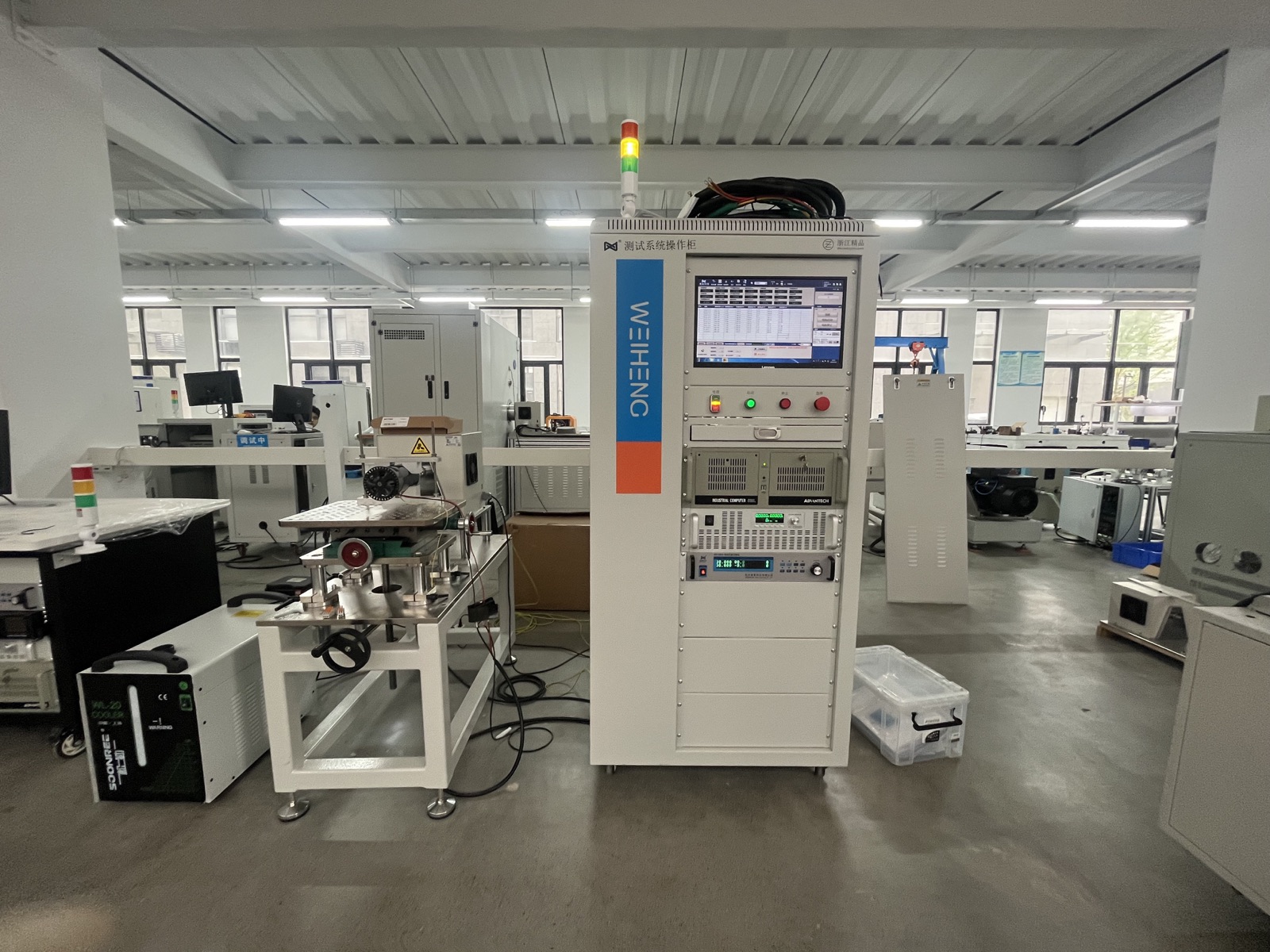
- The original Weiheng workshop photograph proves physical integration of a control cabinet, fixture/test stand, instruments and software display. It does not prove functionality, software features, range, accuracy, calibration, compliance or acceptance.
FAQ
RFQ Preparation Questions
Can I send an RFQ before every parameter is known?
Yes. Send the information currently available and identify open points. The first technical discussion can then focus on the missing values that affect loading, measurement, fixtures, software, or safety.
What is the most important item in a motor test bench RFQ?
There is no single item. The best RFQ connects the motor's operating range with the test objective and mechanical interface. Peak torque, maximum speed, duty cycle, drawings, and required output are often as important as rated power.
Should the RFQ include drawings?
Yes, when available. Shaft, flange, mounting, coupling, and overall dimensions help evaluate fixture design, alignment, guards, and the practical bench layout.
How should unknown RFQ items be handled?
Do not hide them or force an invented value. Mark each item as TBD or supplier-proposed, then record the owner, assumption, basis, consequence, dependency, resolution date and the stage at which it must be closed.
How can buyers compare two motor test bench proposals?
Use the same requirement IDs and require each supplier to mark compliance, deviation, option, exclusion or clarification. Compare technical basis, interfaces, evidence, verification stage, deliverables, changes, responsibilities and total contract boundary—not price alone.
Should FAT and SAT requirements be included in the RFQ?
Yes. Define the intended stages early, but keep them separate. State the available DUT and utilities, method, condition, tolerance, evidence, witness, punch-list process, retest rule and sign-off owner for each applicable stage.