DUT station and interfaces
The fixture, ports, seals, connectors, supports, and changeover method must match the actual pump or pump-motor assembly variants.
 Request a Quote
 Custom Pump Test Equipment
Weiheng configures pump performance test systems around the pump, motor or controller, working liquid, hydraulic circuit, operating points, interfaces, safety, software, data outputs, and acceptance boundary.
Define the complete test method before selecting instruments, fixtures, or circuit hardware.
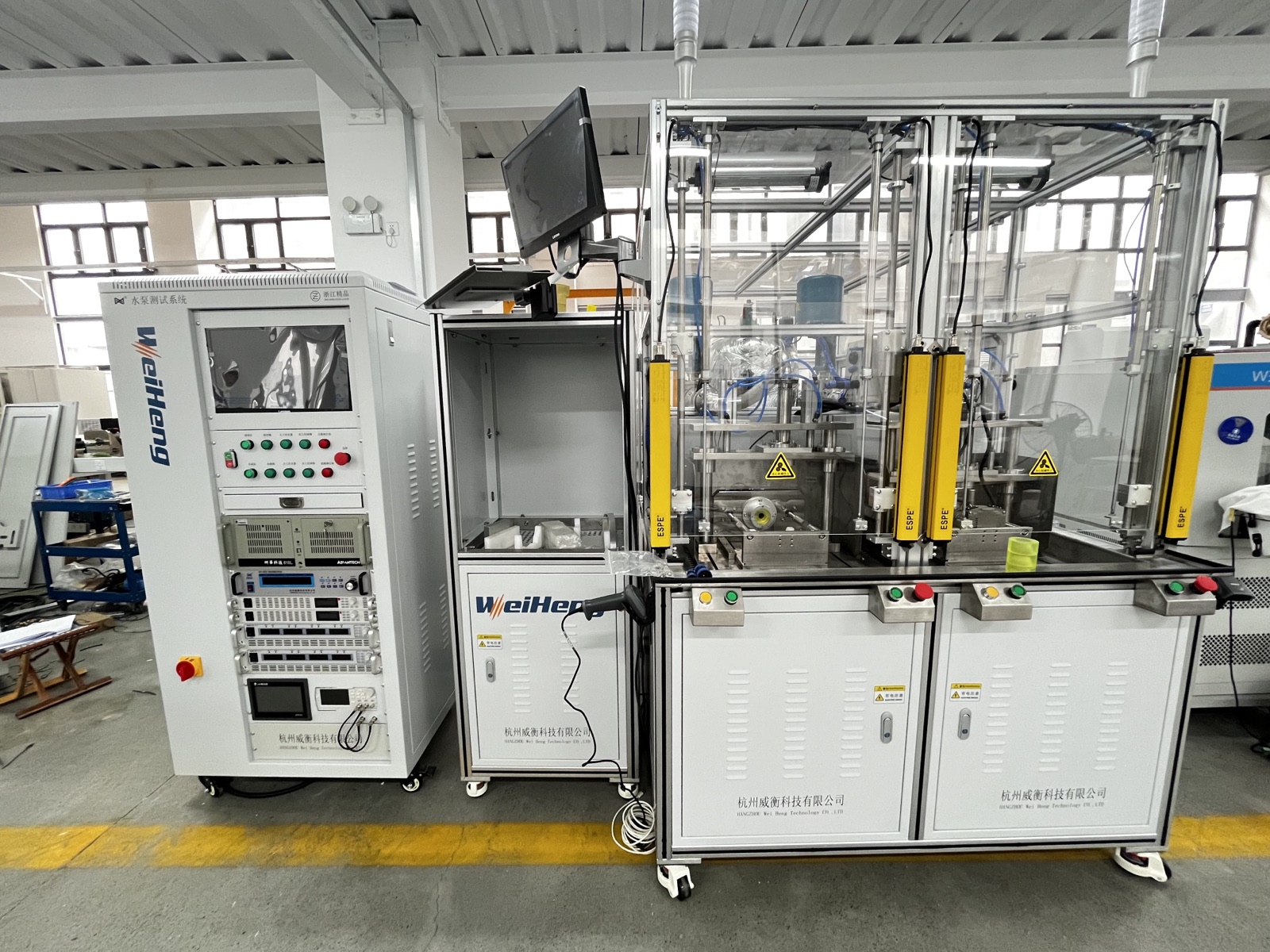
System Definition
A pump performance test system is the integrated DUT station, liquid circuit, power and control, measurement, safety, software, and reporting workflow used to test a pump or pump-motor assembly at defined operating points. The correct configuration follows the pump boundary, liquid, interfaces, required evidence, site conditions, and acceptance plan rather than a universal component list.
System Architecture
Every subsystem should connect to a confirmed requirement or a clearly identified open question.
The fixture, ports, seals, connectors, supports, and changeover method must match the actual pump or pump-motor assembly variants.
Reservoir, piping, valves, filtration, conditioning, drainage, and containment are defined around the selected liquid and operating method.
Power or drive control, sequence logic, limits, guarding, interlocks, emergency response, and operator workflow form one reviewed safety boundary.
Confirmed signals, calculations, curves, records, reports, identification, and system interfaces are tied to the buyer's engineering or quality decision.
Quotation Inputs
Use these inputs to compare supplier proposals against the same DUT, conditions, interfaces, and required outputs.
| Pump and assembly boundary | Pump type, model variants, motor or controller, drawings, ports, mounting, connectors, cooling, accessories, and the parts included in the tested assembly. |
|---|---|
| Liquid and circuit | Working liquid, allowable alternatives, cleanliness, temperature conditions, reservoir, filtration, piping, valves, drainage, filling, and disposal boundaries. |
| Operating points | Required flow, pressure or head, speed, voltage, current, direction, duty cycle, steady-state points, ramps, starts, stops, and any transient sequence. |
| Measurements and calculations | Required hydraulic, electrical, mechanical, thermal, vibration, noise, status, or custom signals; calculation definitions and synchronization needs. |
| Fixture and interfaces | Pump support, port adapters, seals, couplings, harnesses, changeover method, operator access, utilities, floor space, and buyer-supplied interfaces. |
| Control and safety | Operating sequence, drive or power control, pressure and temperature limits, guarding, interlocks, emergency stops, leak response, and safe service access. |
| Software and records | Recipes, user permissions, live values, curves, raw and processed data, reports, pass/fail rules, serial identification, database, or factory-system interfaces. |
| Acceptance boundary | Test article, agreed conditions, sequence, reviewable outputs, supplied items, exclusions, documentation, site-dependent work, and exception handling. |
Engineering Workflow
State whether the system supports engineering characterization, design comparison, durability work, quality control, production release, or another documented decision.
Confirm the pump variants, motor or controller, working liquid, ports, fixtures, site utilities, and what each party supplies.
List the conditions, sequence, stabilization or transition rules, repetitions, limits, and outputs required at each point.
Connect each sensor, control function, calculation, record, curve, and report to a stated requirement or open assumption.
Use the same DUT, liquid, conditions, sequence, outputs, exceptions, and delivery boundary in the proposal and acceptance discussion.
Proposal Review
A useful proposal shows how the system answers the defined test decision and where assumptions still remain.
Related Planning
Prepare the pump, liquid circuit, operating points, interfaces, data, safety, and acceptance inputs before requesting a proposal.
Build the pump RFQCompare complete test benches, dynamometer systems, application-specific equipment, and production EOL routes.
Compare equipment routesTranslate the DUT, operating envelope, loading, measurement, mechanics, controls, software, and reports into a reviewable system.
Open configuration guidePrepare drawings, operating conditions, test items, interfaces, data, delivery, and acceptance information.
Open RFQ checklistReview the broader loading, measurement, fixture, controls, software, and reporting boundary for a complete motor test bench.
Review motor test benchFAQ
A pump performance test system combines the DUT station, liquid circuit, power or drive control, measurement, safety, software, and reports needed to test a pump or pump-motor assembly under defined conditions. Its configuration depends on the pump boundary, liquid, operating points, required evidence, interfaces, and acceptance method.
Provide the pump and motor or controller models, drawings, port and fixture details, working liquid, operating-point matrix, required measurements and calculations, power and site utilities, safety requirements, data and report needs, target country, and planned acceptance method.
A configurable system may support multiple variants, but each model needs a confirmed fixture, port, seal, electrical, operating, software, and safety boundary. Variant coverage should be stated in the proposal instead of assumed.
Not always. Motor testing can focus on electrical and mechanical behavior, while pump performance testing also depends on the liquid circuit and hydraulic conditions. A combined assembly test must define both boundaries and the calculations that connect them.
The liquid affects materials, filtration, conditioning, seals, cleaning, containment, safety, and disposal. Shared hardware may be possible only after these differences and the required operating conditions are reviewed.
No. The image confirms a physical Weiheng pump test system with visible integration. Flow range, pressure range, measurement capability, accuracy, standards, cycle time, and acceptance require project-specific specifications and evidence.
Request a Proposal
Share the pump and motor or controller, drawings, working liquid, operating points, required measurements and reports, interfaces, site utilities, target country, and acceptance method.