
Direct Answer
What information is needed for a pump motor test system RFQ?
A pump motor test system RFQ should define eight connected groups: DUT and decision, liquid and circuit, operating-point matrix, interfaces, measurements and calculations, control and safety, data and reports, and verification or acceptance. For each open item, state whether it is known, a target, TBD, supplier-proposed or excluded. This lets suppliers quote the same physical boundary and makes assumptions, options and buyer responsibilities visible.
Eight Input Groups
Build the RFQ from the pump boundary to acceptance.
| Input group | What to prepare |
|---|---|
| 1. DUT and decision | Pump type and variants; included motor, controller, cooling and accessories; drawings and revisions; whether the decision is characterization, comparison, durability, QC or production release. |
| 2. Liquid and circuit | Working liquid, alternatives, temperature and cleanliness, reservoir, piping, filtration, valves, conditioning, filling, drainage, containment and disposal responsibilities. |
| 3. Operating-point matrix | Required flow, pressure or head, speed, voltage and current conditions; direction, duty, steady points, ramps, starts, stops, transitions, dwell, repetitions and thermal state. |
| 4. Mechanical and electrical interfaces | Ports, seals, supports, shaft or coupling, harnesses, connectors, fixture changeover, controller communication, utilities, floor space and buyer-supplied items. |
| 5. Measurements and calculations | Hydraulic, electrical, mechanical, thermal, vibration, noise and status channels; units, planes, formulas, synchronization, invalid-data handling and the decision supported by each output. |
| 6. Control and safety | Sequence ownership, drive or power control, limits, alarms, guarding, interlocks, emergency stop, leak response, pressure and temperature protection, operator roles and service access. |
| 7. Data and reports | Recipes, user permissions, raw and processed data, curves, calculations, serial identification, pass/fail rules, report fields, export, retention, backup, database and factory interfaces. |
| 8. Verification and acceptance | Test article, agreed liquid and conditions, sequence, outputs, tolerances, witness, exceptions, supplied items, exclusions, documents, punch-list handling, retest and sign-off owner. |
Operating-Point Matrix
Make each pump test point reviewable.
A headline flow or pressure value does not define the sequence. Use one row for every required point or transition so the command, condition, recorded evidence and exception handling remain connected.
| Field | What to record |
|---|---|
| Point ID | A stable identifier linked to the requirement and report. |
| DUT state | Variant, setup, liquid condition, thermal condition and relevant revision. |
| Commands | Speed, voltage, duty, valve or other controlled inputs and transition method. |
| Expected condition | Target flow, pressure/head, electrical/mechanical state and stabilization rule. |
| Recorded channels | Named raw signals, timestamps, units and calculation inputs. |
| Decision output | Curve, comparison, limit, status, report field or open engineering observation. |
| Exception rule | Invalid condition, alarm, interruption, retest and record-retention treatment. |
Proposal Review
Five checks before comparing pump test quotations.
- The proposed DUT station, circuit, controls, measurement, safety, software, utilities and buyer-supplied items use the same boundary as the RFQ.
- Every operating point maps to named commands, channels, calculations, decision outputs and exception rules.
- Each pump variant has a confirmed port, seal, fixture, harness, software and safe-changeover method.
- Unknowns are marked TBD or supplier-proposed with an owner, assumption, consequence and resolution stage.
- Acceptance is tied to an agreed DUT, liquid, condition, sequence and reviewable record instead of a photograph or generic claim.
Related System
Connect the RFQ to a reviewable configuration.
Review the Pump Performance Test System for the complete DUT station, liquid circuit, controls, measurement, safety and reporting boundary. Use the Motor Testing Equipment Selection Guide to normalize different supplier proposals, and the Motor Test Data and Acceptance Planning Guide to define records, exceptions and sign-off evidence.
FAQ
Pump Motor Test Plan Questions
What should a pump motor test system RFQ include?
Include the complete pump and motor or controller boundary, working liquid and circuit, operating-point matrix, interfaces, measurements, calculations, control and safety, software and data, site conditions, target country, reports, responsibilities and acceptance method.
Do all operating points need to be final before requesting a quotation?
No. Confirmed points should be separated from targets and open questions. Mark unknown items TBD or supplier-proposed, then record the assumption, owner, impact and resolution stage instead of inventing a value.
How is a pump motor test different from a motor-only test?
A motor-only test can focus on electrical and mechanical behavior. A pump assembly test also depends on the liquid, hydraulic circuit, ports, seals, operating conditions and the calculations that connect motor input to pump output.
Can one test system support several pump variants?
Potentially, but each variant needs reviewed fixtures, ports, seals, electrical interfaces, operating points, software recipes, protection and changeover. Variant coverage should be explicitly quoted and verified.
What should a pump test report contain?
The report should identify the DUT and revision, setup, liquid and condition, sequence, recorded channels, calculations, curves or limits, exceptions, retests, software or method version and the agreed sign-off context.
Does the factory image prove flow range, pressure range or accuracy?
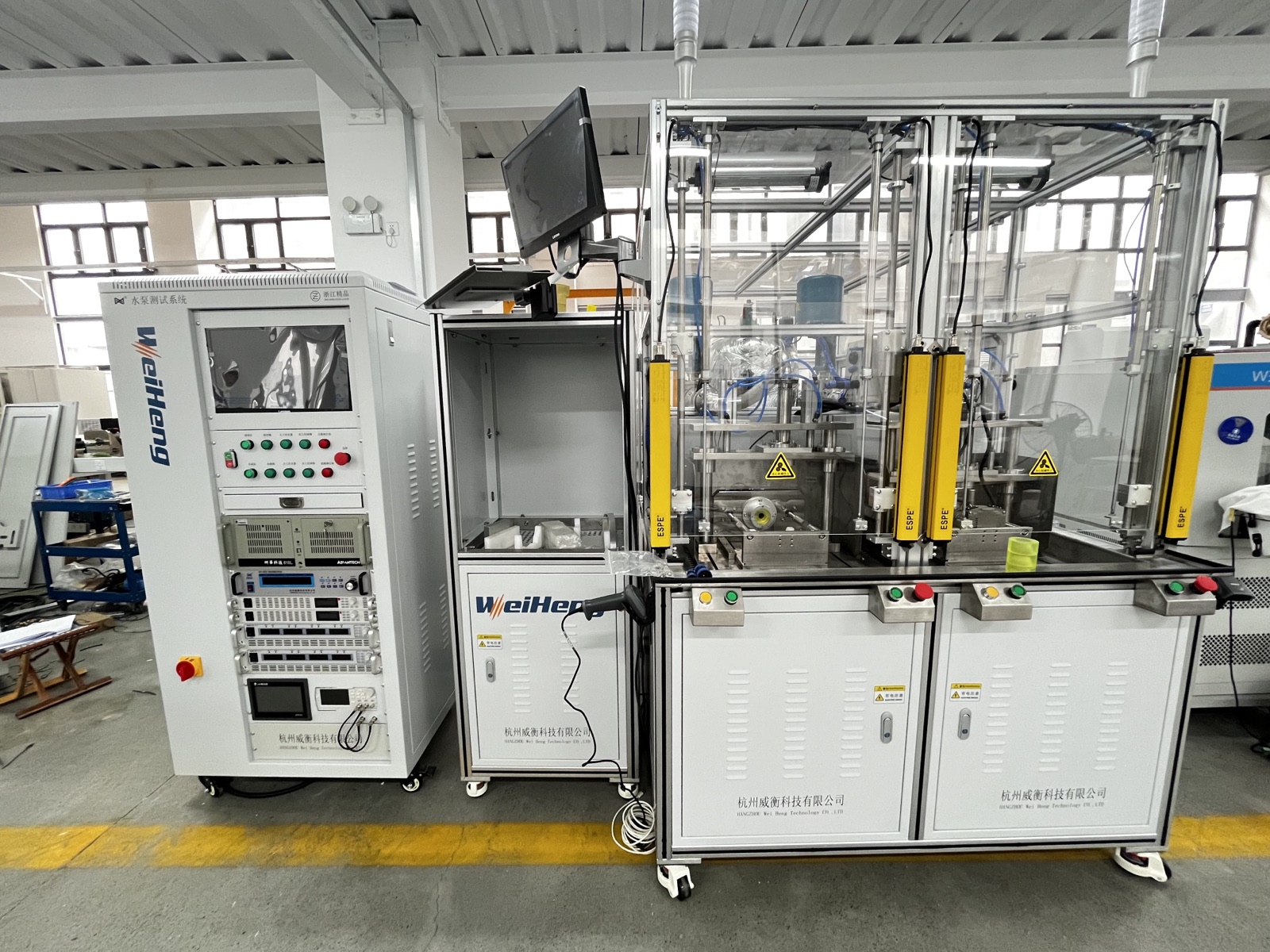
No. It verifies visible physical integration only. Numerical capability, accuracy, cycle time, standards and acceptance require project-specific specifications, methods and records.